
A comprehensive guide to the Development, Evolution, and Principles of Depth Filtration
Depth filtration plays a crucial role in the biopharmaceutical industry. It efficiently removes impurities, enhances product safety, improves product stability, and increases process efficiency, making it an indispensable step in biopharmaceutical manufacturing.
The Alioth “Deep In, Clear Out” Knowledge Series is now available, helping you gain a deeper understanding of depth filtration. In this episode, we will explore the development, evolution, and principles of depth filtration.
The development and evolution of Depth Filtration
For over 4,000 years, depth filtration has been an essential part of water purification technology---from using sand to filter drinking water around 1500 BC to the world’s first municipal water purification system in Scotland in the early 19th-century.
The original Cohn cold ethanol plasma fractionation process used depth filtration with diatomaceous earth as a filter aid to remove suspended particles during the purification of albumin and serum lgG.
Single-use depth filters specifically designed for bioprocessing applications are used for the pretreatment of process fluids to remove critical contaminants, thereby enhancing the performance of subsequent chromatography or filtration steps.
The development of new depth filtration materials and devices with enhanced performance characteristics aims to achieve greater capacity, higher impurity removal efficiency, and lower levels of extractables and leachables. These advancements enable the implementation of continuous manufacturing processes.
The principles of Depth Filtration
Depth filtration uses a depth (thickness) matrix of the filter media to capture suspended particles and separate them from the liquid carrying them. Depth filters primarily use cellulose as the filtration medium.
The space between the fibers is used to capture the particles in the feed liquid. With the progress of filtration, the particles accumulate on the surface to form filter cake, which will improve the efficiency of filtration. At the same time, as the filter cake becomes thicker, the filtration speed will be reduced.
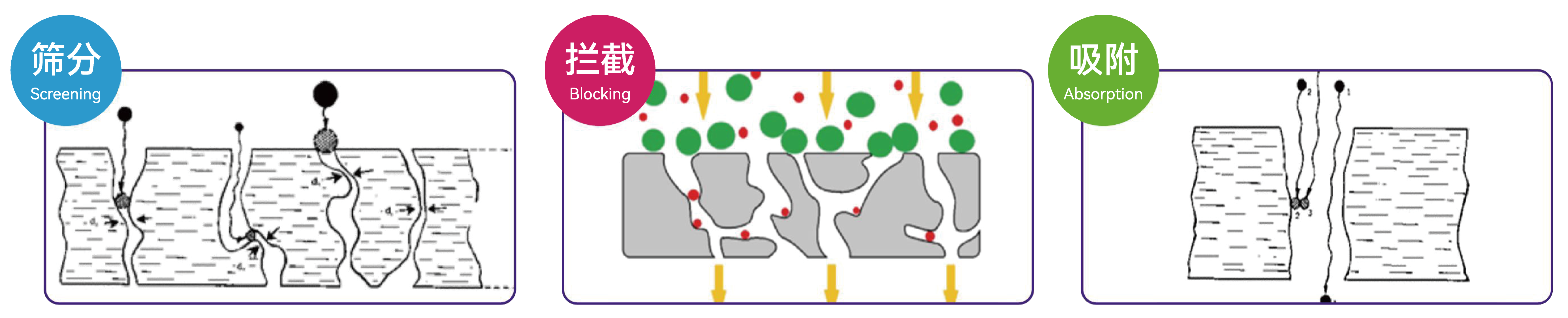
There are three retention mechanisms in depth filtration:
Screening: Directly intercept particles larger than medium’s pores.
Interception: The tortuous path in the medium leads to energy loss when particles pass through, and captures the particles in the medium.
Absorption: Particles are adsorbed in the medium due to intermolecular physical, chemical or electrostatic attraction.
Comparison between Depth and Surface Filtration
|
|
Surface Filtration |
Depth Filtration |
|
Grade of Filtration |
Absolute Filtration |
Nominal Filtration |
|
Holding Capacity |
Low |
High |
|
Service Life |
Short |
Long |
|
Applicable Feed Stream |
Low turbidity/post-prefiltration feed |
High turbidity feed |
|
Initial Pressure Drop |
Increase quickly |
Low and stable |
|
Applicable Process Step |
Downstream end-filtration |
Upstream prefiltration |

